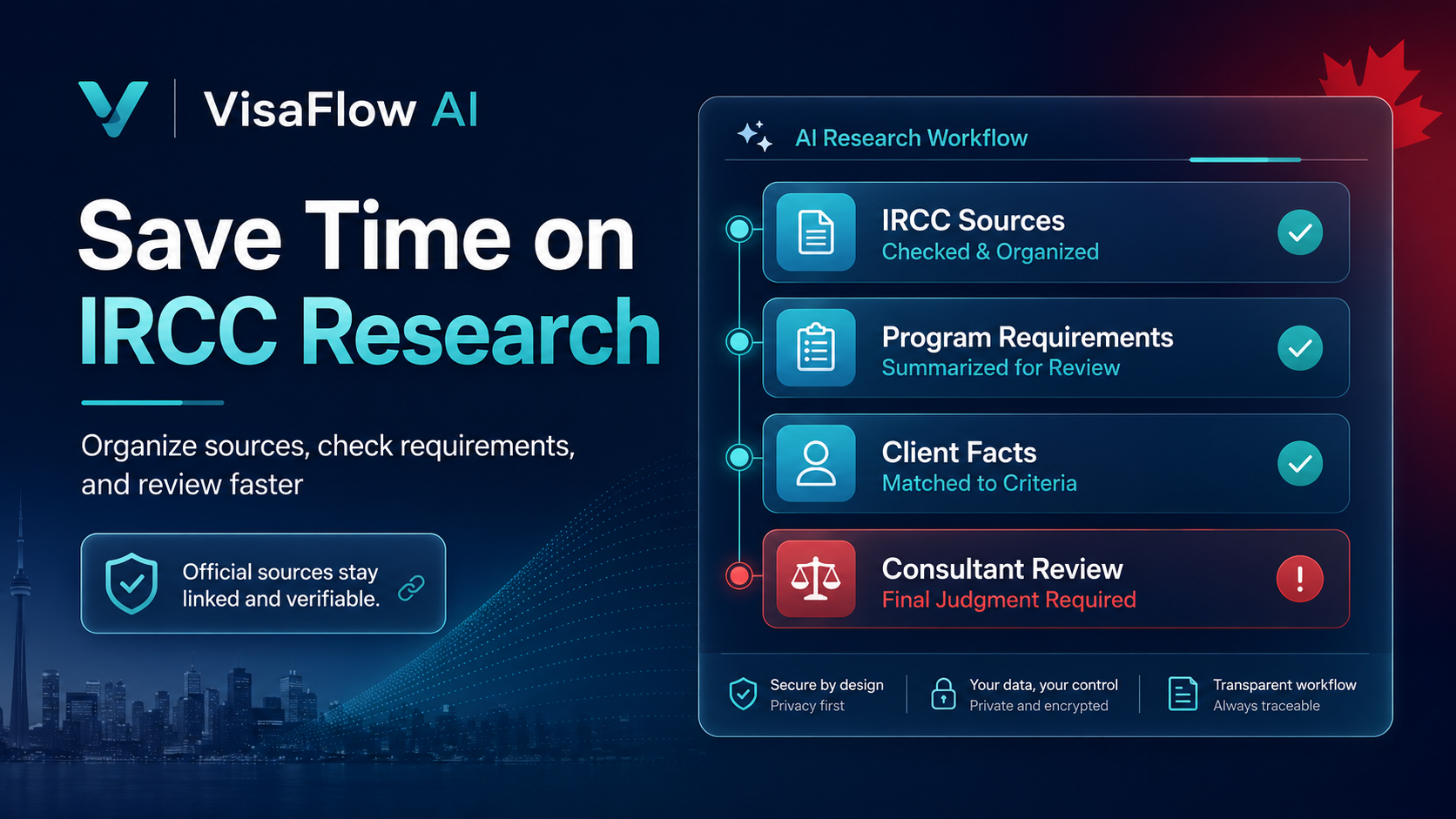
Why IRCC Research Takes So Much Time
Immigration consultants rely on accurate, up-to-date information from Immigration, Refugees and Citizenship Canada (IRCC). But finding and verifying that information can be surprisingly time-consuming. IRCC publishes program delivery instructions, policy frameworks, and operational guidance across a large number of official pages. Requirements vary significantly by program, and consultants often need to check the same details repeatedly for different clients.
Several factors contribute to the time burden:
- Guidance is spread across multiple pages. Program delivery instructions, eligibility criteria, document checklists, and processing times are rarely in one place.
- Requirements vary by program. A study permit review involves different criteria than a spousal sponsorship or an Express Entry profile.
- Details must be verified repeatedly. Even familiar programs can change, and consultants need to confirm they are looking at the current version of the guidance.
- Policy language can be dense. Reading and interpreting official IRCC language takes focused attention, especially under time pressure.
- Research must be accurate and source-backed. Notes that lack a source link or a date checked are hard to rely on later.
The result is that immigration professionals can spend hours each week on research tasks that feel repetitive — not because the work is simple, but because the same sources need to be revisited and reorganized for each case.
Start with a Repeatable Research Checklist
One of the simplest ways to save time on IRCC research is to use a repeatable checklist for every case review. Instead of starting from scratch, a structured checklist helps ensure nothing is missed and reduces the mental effort of remembering every step.
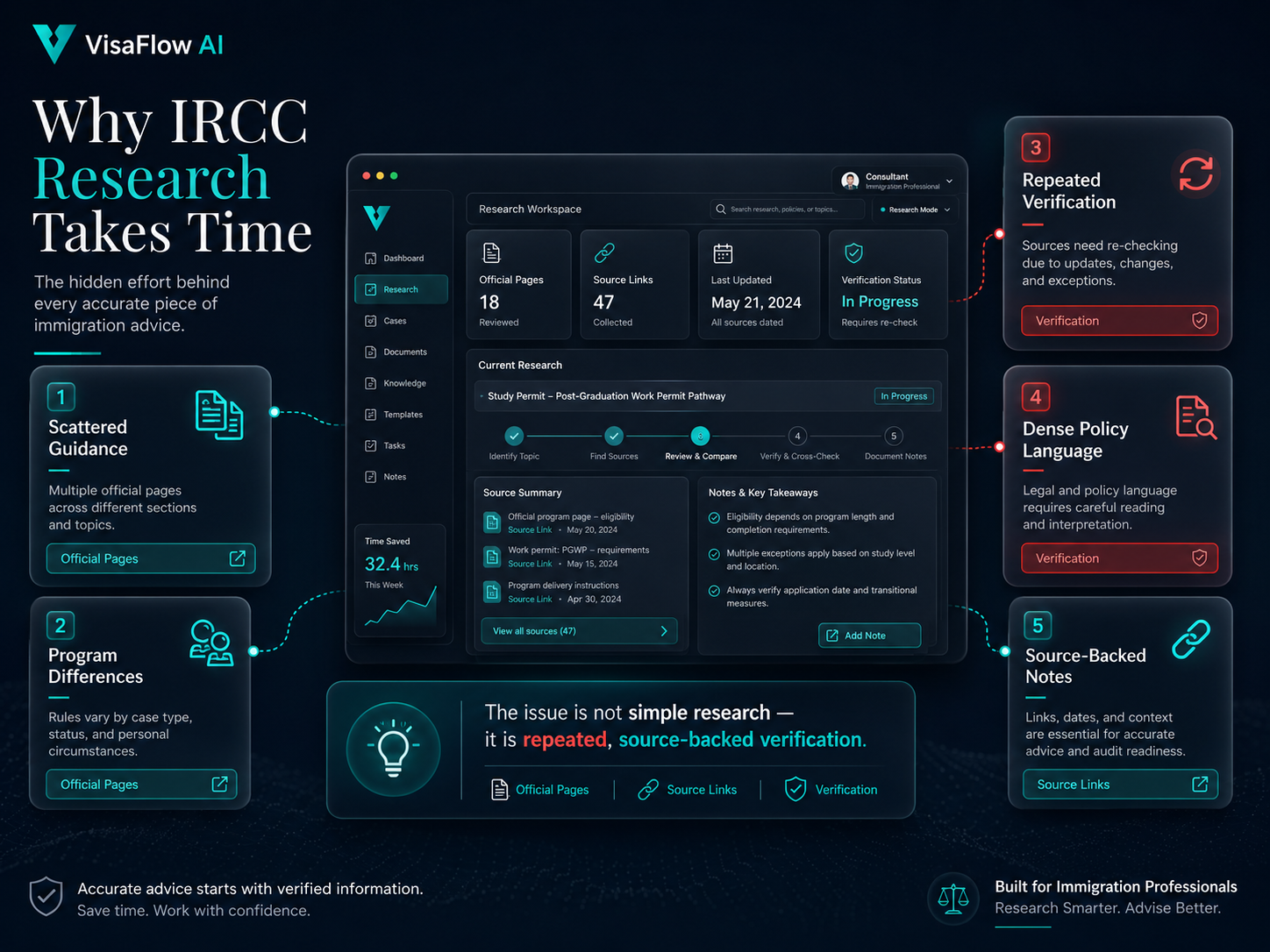
Here is a practical set of items to include in every research checklist:
IRCC Research Checklist
- Program category and sub-category
- Eligibility criteria from official IRCC guidance
- Required documents and forms
- Current IRCC program delivery instructions
- Common refusal risks for this program
- Processing times and considerations
- Client-specific facts to verify against criteria
- Source URLs and date each source was checked
A checklist like this helps standardize the research process across a team and reduces the chance of overlooking a key detail. It also makes it easier to hand off a partially completed review to a colleague.
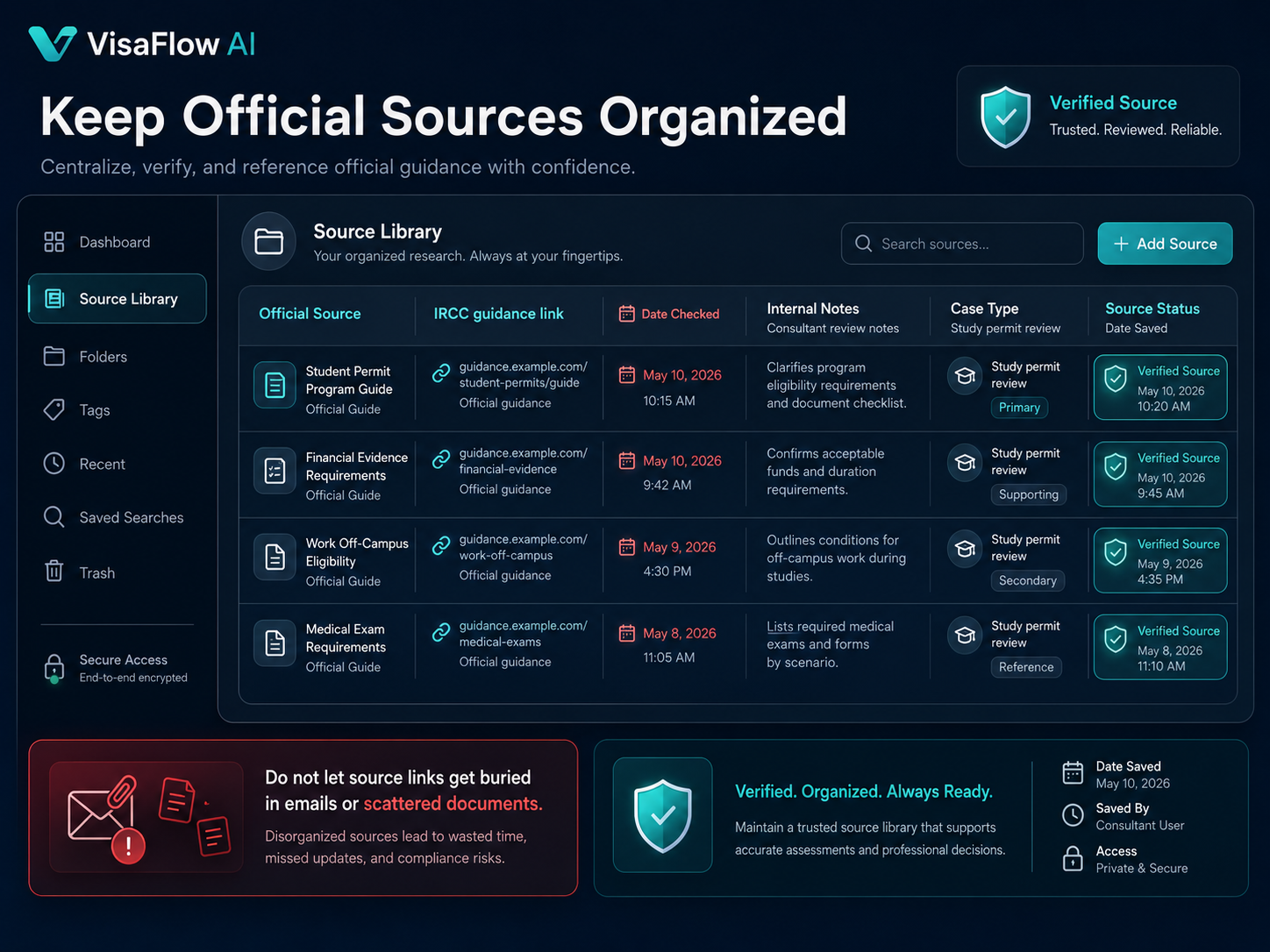
Keep Official Sources Organized
Disorganized research notes are one of the biggest hidden time drains in immigration practice. When source links are buried in emails, scattered across documents, or only stored in someone's memory, the same IRCC pages get searched for and re-read over and over.
Simple source organization practices can save significant time:
- Save IRCC source URLs alongside your notes, not in a separate file.
- Record the date each source was checked so you know how current it is.
- Keep official IRCC guidance separate from your internal analysis and notes.
- Use consistent naming conventions for saved research so it is easy to find later.
- Maintain clean records that a team member or reviewer can follow.
Organized sources also reduce the risk of relying on outdated information. When every source has a date, it is easier to know when to re-check.
Use Templates for Common Research Tasks
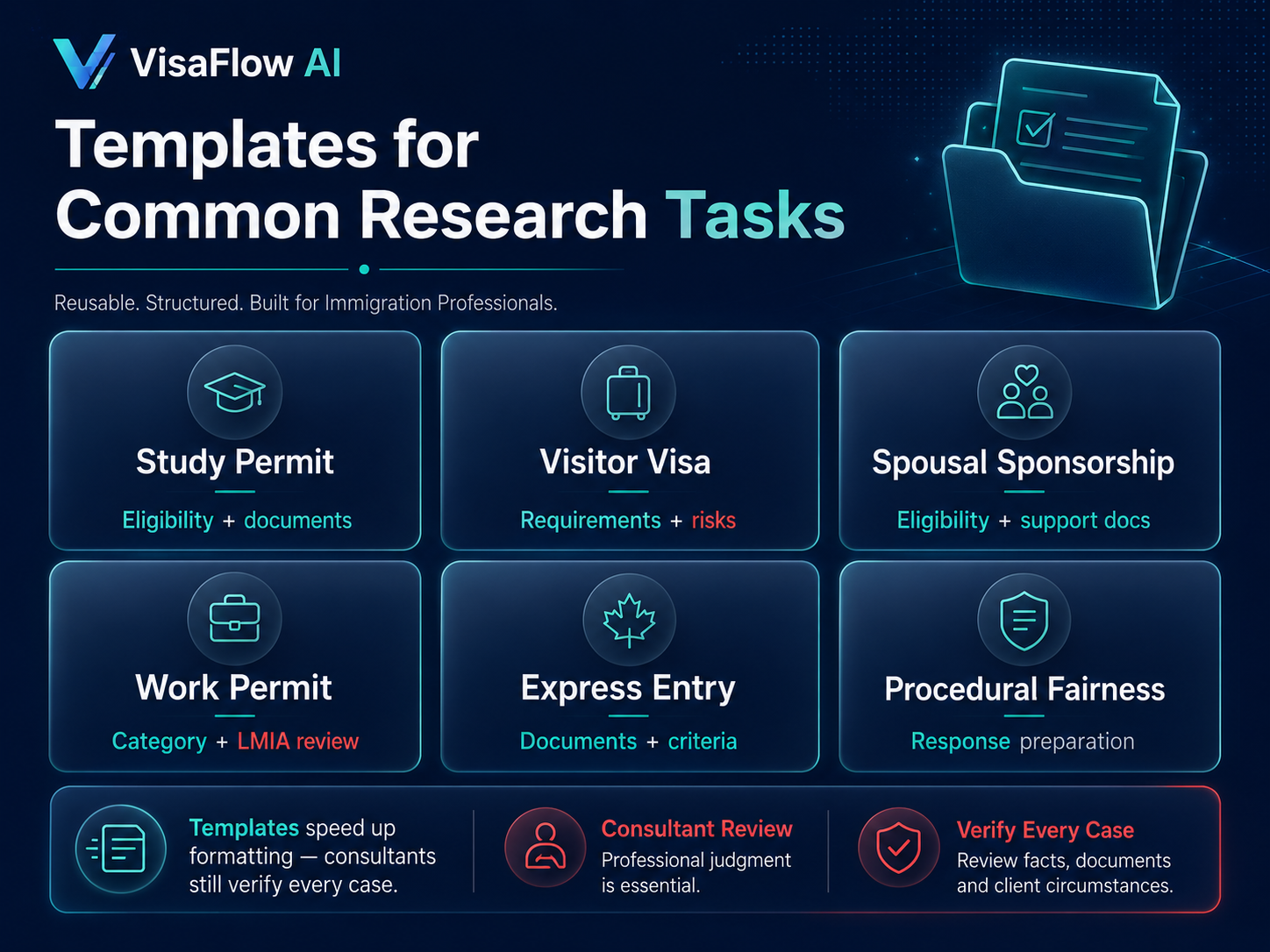
Many immigration case types follow similar patterns. A study permit review, a visitor visa assessment, and a spousal sponsorship eligibility check each have recurring criteria and document requirements. Creating research templates for these common case types helps reduce repetitive formatting, ensures consistent coverage, and speeds up the initial review phase.
Examples of templates that can support research workflows:
- Study permit eligibility and document review
- Visitor visa requirements and refusal risk assessment
- Spousal sponsorship eligibility and supporting document checklist
- Work permit category and LMIA requirements review
- Express Entry document and eligibility verification
- Procedural fairness response preparation
Templates are not a substitute for professional judgment. They are a starting point that helps ensure consistent coverage and reduces the time spent reformatting the same type of review from scratch.
Reduce Repeated Lookups with a Research Workflow
A structured research workflow helps consultants move through each case review methodically, reducing the need to jump between sources and tasks. When the steps are clear, the research becomes faster and easier to document.
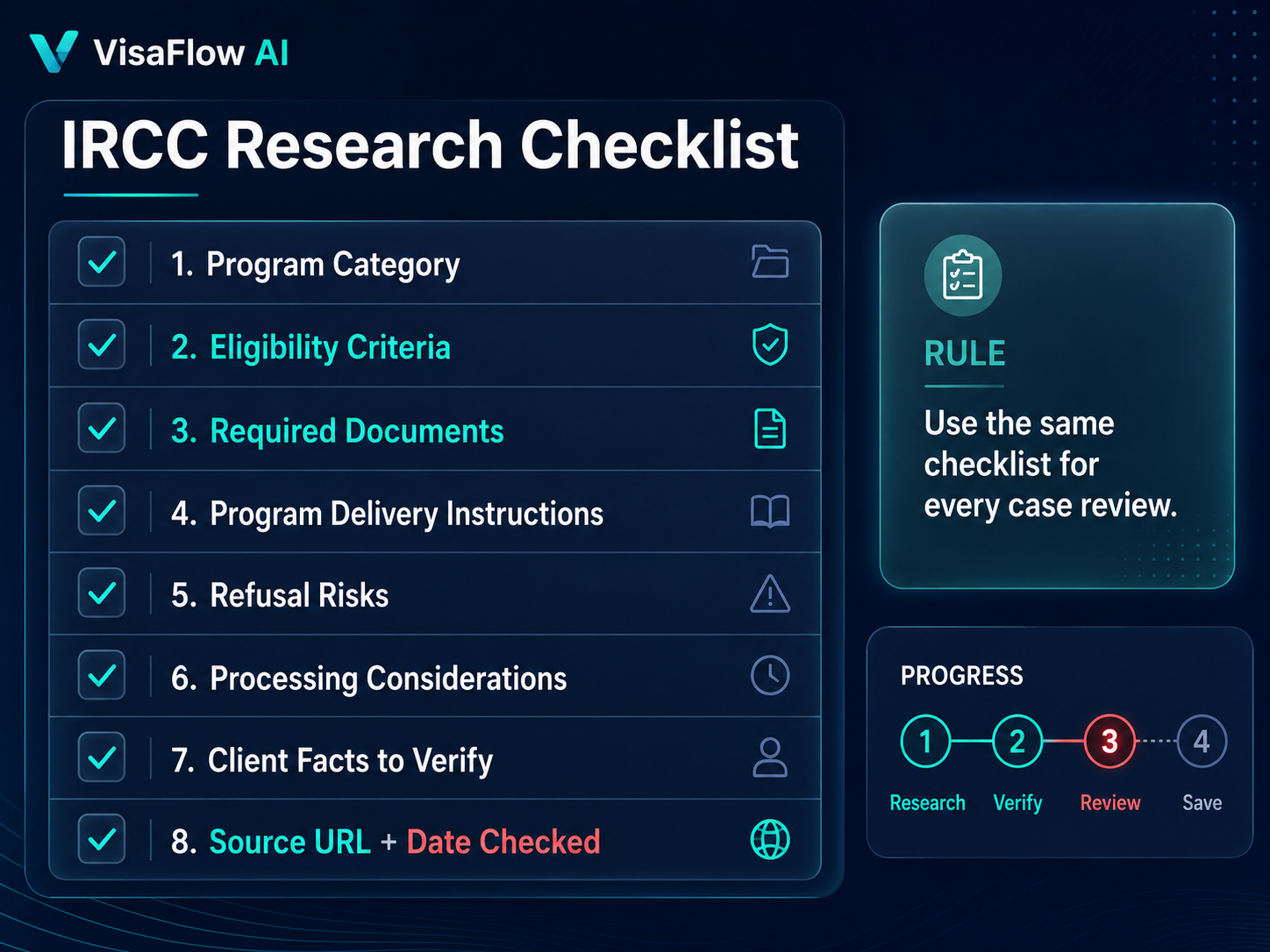
Consider adopting a workflow like this:
- Identify the program or issue. Clarify exactly which immigration program, category, or policy question needs to be researched.
- Gather official source material. Find the relevant IRCC program delivery instructions, policy pages, and document checklists.
- Summarize the relevant requirements. Extract the key criteria, deadlines, and conditions that apply to the case.
- Compare requirements against client facts. Note where the client's situation aligns with or departs from the stated criteria.
- Flag areas needing professional review. Identify where professional judgment, discretion arguments, or further analysis is needed.
- Save sources and notes for future reference. File the research so it can be referenced again without re-doing the work.
This kind of workflow keeps the consultant in control at every step and ensures that research is documented in a way that supports team collaboration and future reviews.
Where AI Can Help — Safely
Artificial intelligence tools, including VisaFlow AI, can assist immigration professionals with certain research and workflow tasks. Used responsibly, AI can help reduce the time spent on repetitive lookup and organization work.
AI can support immigration research by:
- Organizing research notes and source links in a structured format
- Summarizing longer IRCC guidance pages for faster review
- Finding related topics and cross-referencing program requirements
- Creating first-pass checklists based on program categories
- Drafting internal review notes for consultant verification
- Helping teams locate source-backed information more quickly
However, responsible use is essential. AI tools should never replace professional judgment or be treated as a source of legal advice. The consultant remains fully responsible for verifying all information against official IRCC sources and for applying their professional judgment to each client's specific facts.
Important guidelines when using AI in immigration research:
- The consultant remains responsible for final review and decision-making.
- Official IRCC sources must always be checked. AI outputs should be treated as a starting point, not an authoritative source.
- AI output is not legal advice. It is a productivity aid, not a substitute for professional qualifications.
- Sensitive client information should be handled with care and in accordance with privacy obligations.
Protect Client Privacy and Data
Immigration professionals handle sensitive personal information. When using productivity tools or AI-assisted workflows, it is important to maintain strong privacy practices.
- Avoid entering unnecessary personal client details into third-party tools that do not need them.
- Use privacy-conscious workflows that limit exposure of personally identifiable information.
- Keep internal notes professional and stored in secure systems.
- Follow your firm's policies and Canadian privacy expectations.
- Be thoughtful about what information is shared with AI tools and what should remain in your internal case management system.
Signs Your Firm Needs a Better Research System
If any of the following sound familiar, it may be time to re-evaluate how your team approaches immigration research:
- The same IRCC questions are researched repeatedly by different team members.
- Research notes are scattered across email threads, Word documents, and sticky notes.
- Team members use different IRCC source links for the same program.
- Research takes too long to complete before client consultations.
- It is hard to find what was checked the last time a similar question came up.
- New staff need extensive manual guidance for basic research tasks.
- Source verification is inconsistent across the team.
Addressing these challenges does not require a complete overhaul. Small changes to how research is structured, documented, and shared can lead to meaningful time savings.
IRCC Research Efficiency Checklist
Use this checklist as a quick reference for building a more efficient research workflow:
Efficiency Checklist
- Use a standard research template for each case type
- Save source URLs with the date each was checked
- Separate client facts, official sources, and internal notes
- Create repeatable review steps for common programs
- Avoid storing unnecessary client details in research tools
- Review AI-assisted notes before relying on them
- Keep final judgment and review responsibility with the consultant
- Re-check official IRCC guidance before relying on it
Frequently Asked Questions
No. AI should not replace licensed immigration professionals or professional judgment. It can support research organization and workflow efficiency, but consultants remain responsible for final review and advice.
By using repeatable checklists, organized source links, templates for common case types, and tools that help summarize and structure official guidance for review.
No. Consultants should always verify information against official IRCC sources and apply professional judgment to the client's specific facts.
Common tasks include checking program requirements, reviewing document lists, comparing client facts to eligibility criteria, preparing internal notes, and saving source-backed research for future review.
Conclusion
The most efficient immigration research workflow combines official IRCC sources, repeatable templates, careful professional review, and productivity tools that reduce manual lookup time — without replacing professional judgment. Small improvements in how research is structured and documented can lead to meaningful time savings across your practice.
VisaFlow AI is designed to support immigration research workflows. It does not provide legal advice, replace professional judgment, or guarantee immigration outcomes. Consultants should always verify information against official IRCC sources.