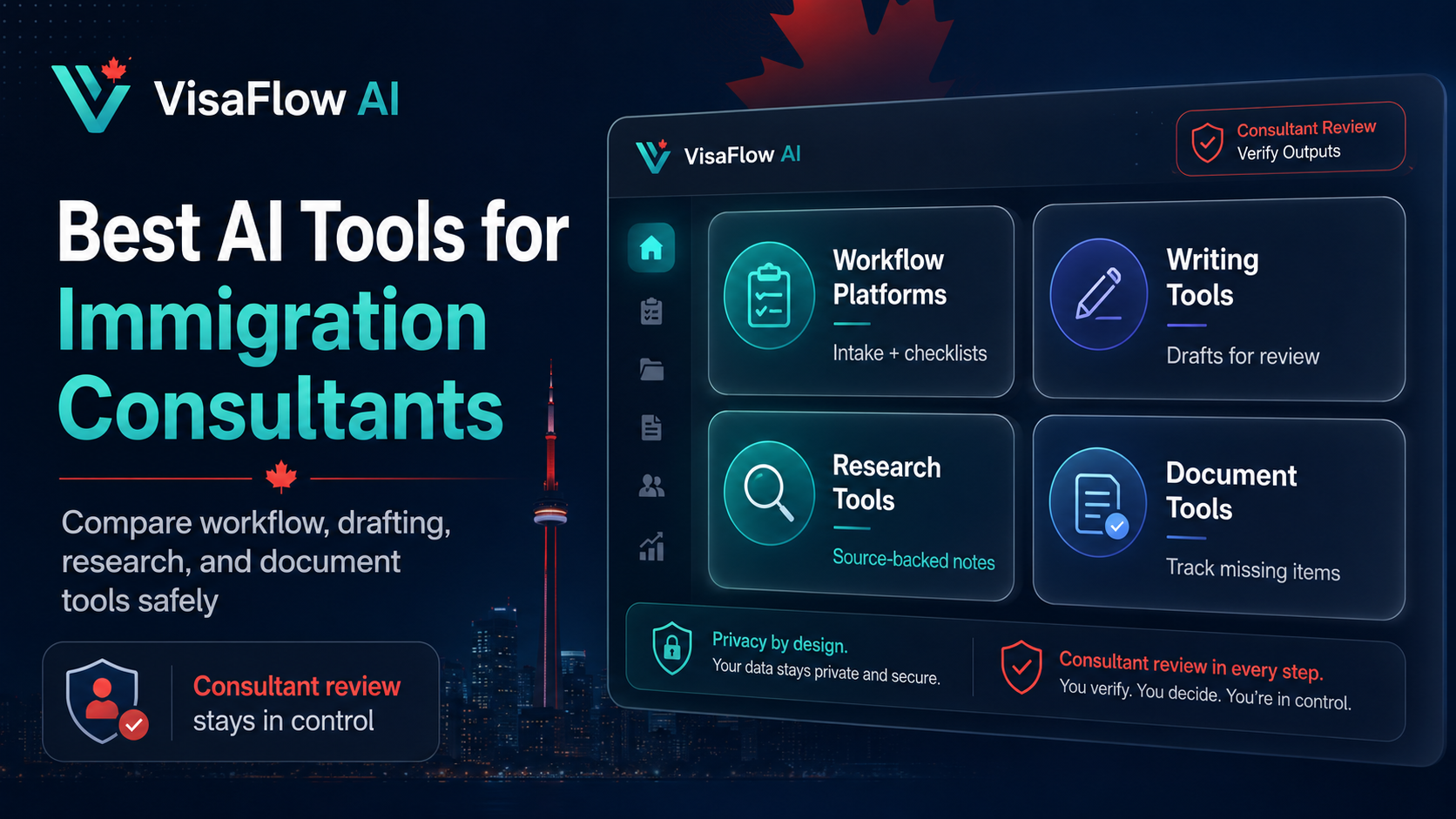
Why AI Tools Are Gaining Attention in Immigration Consulting
Canadian immigration consultants manage a document-heavy, deadline-driven workflow. Client intake, document checklists, IRCC research, follow-up communications, and case preparation notes all require significant time. AI tools can assist with the structured and repeatable parts of these tasks, freeing consultants to focus on professional review and client service.
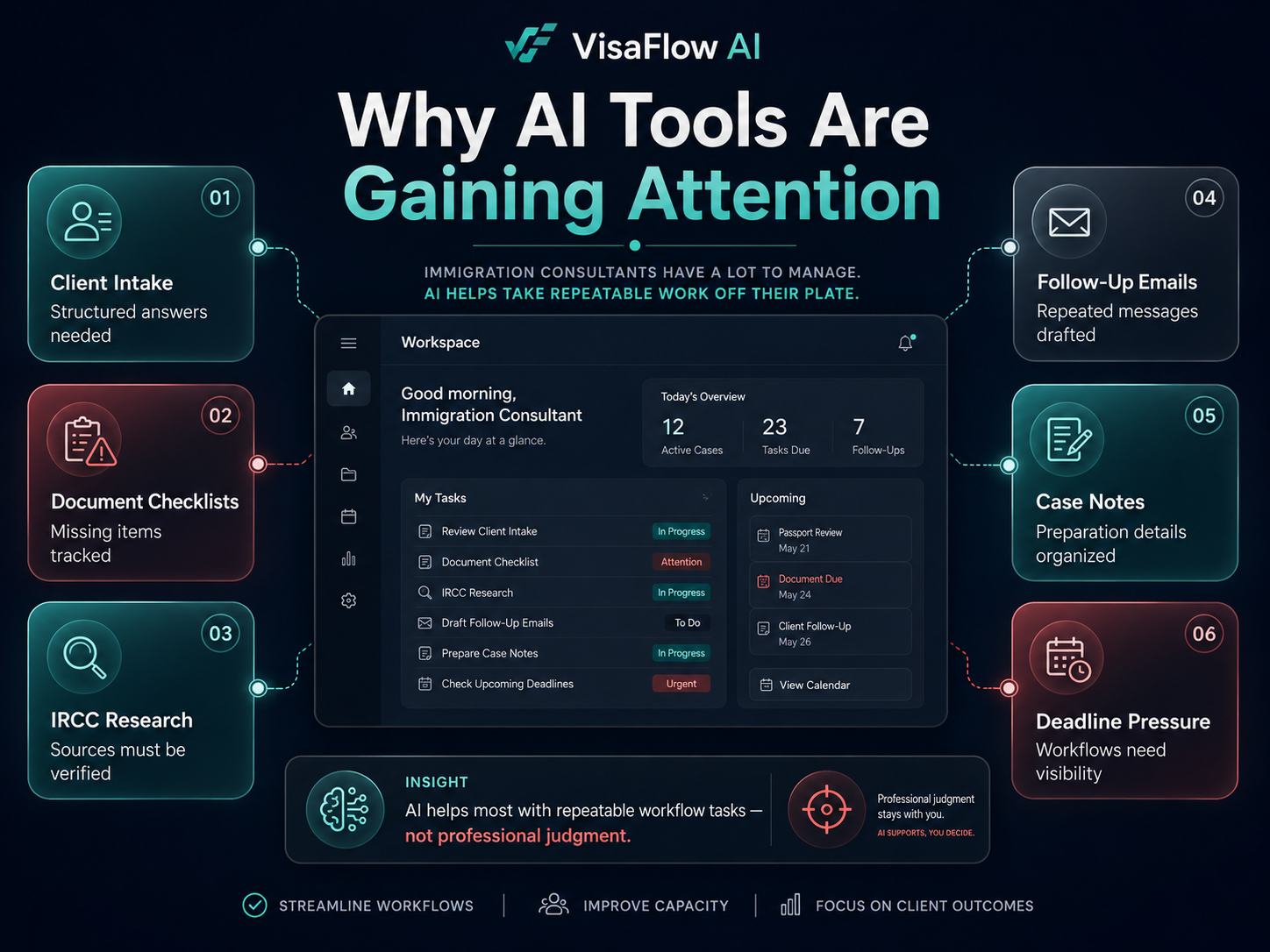
The key is understanding what AI can and cannot do. AI tools excel at tasks that follow predictable patterns: drafting messages from templates, summarizing structured information, generating checklist drafts, and organizing research into coherent notes. They do not replace the consultant's judgment, legal knowledge, or professional responsibility.
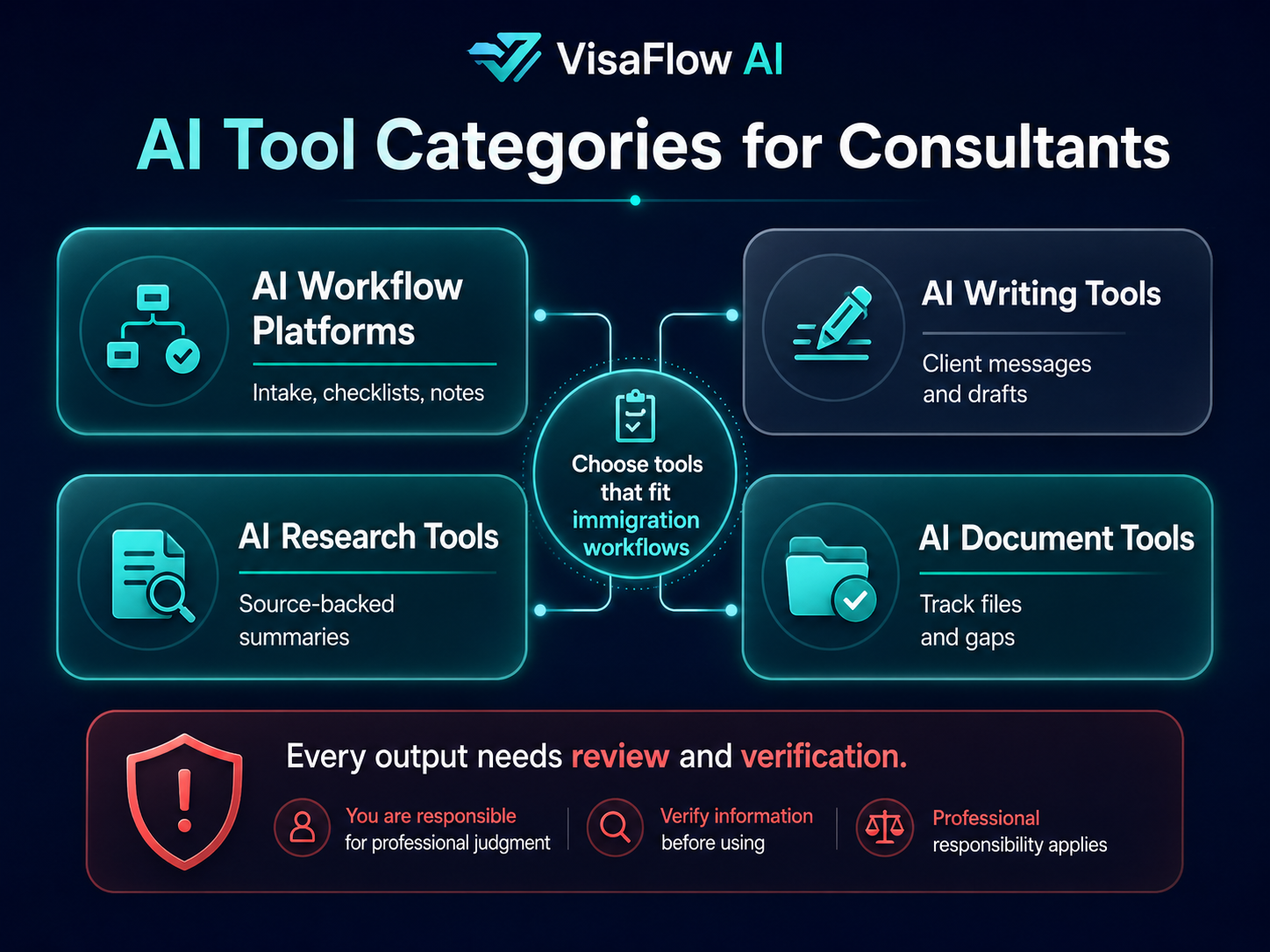
For immigration consultants evaluating AI tools for immigration consultants Canada, the most useful categories fall into a few distinct areas.
Category 1: AI-Assisted Workflow Platforms
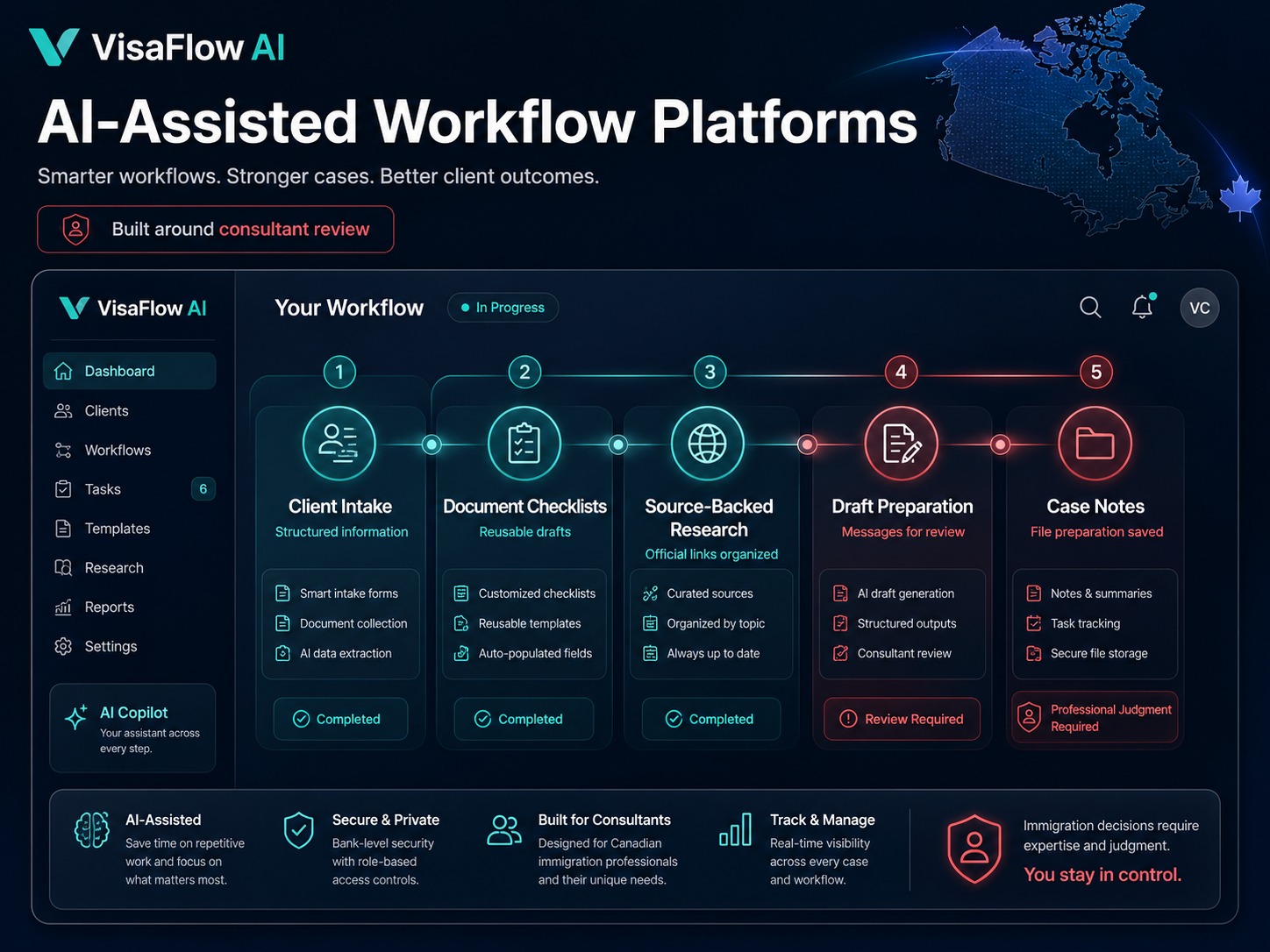
The most relevant category for immigration consultants is purpose-built AI-assisted workflow platforms. These tools are designed specifically for immigration practice and combine multiple capabilities in one workspace.
What they help with:
- Client intake organization. Collect and structure client information, questionnaires, and documents in a central workspace instead of scattered emails and notes.
- Document checklist workflows. Create reusable checklist drafts for common application types and track which documents have been received.
- Source-backed research support. Find and organize IRCC program requirements, document lists, and policy information with AI-assisted source organization.
- Draft preparation. Generate first drafts of client messages, follow-up reminders, and internal notes for consultant review.
- Case preparation notes. Keep structured notes and review findings organized per client file.
Platforms like VisaFlow AI are built specifically for Canadian immigration workflows. They focus on productivity and organization while keeping professional review at the center.
Category 2: AI Writing and Drafting Tools
General-purpose AI writing tools can help immigration consultants draft client communications faster. These tools use large language models to generate text based on prompts provided by the user.
Common use cases:
- Drafting client intake request emails and follow-up reminders.
- Generating status update messages for active case files.
- Creating draft cover letters or supporting statements for consultant review.
- Writing internal case notes and preparation summaries.
The critical consideration with general-purpose writing tools is that they are not designed for immigration workflows. They have no understanding of IRCC program requirements, document checklists, or professional obligations. Every output must be carefully reviewed, verified against official sources, and customized by the consultant before use.
Immigration-specific platforms like VisaFlow AI integrate drafting support directly into the workflow, reducing the need to switch between separate tools.
Category 3: AI Research and Summarization Tools
Research is one of the most time-consuming parts of immigration practice. IRCC program requirements, document lists, processing procedures, and policy updates are spread across multiple official pages. AI research and summarization tools can help organize this information more efficiently.
How they help:
- Summarizing IRCC program pages into structured notes with source references.
- Organizing document requirements by application category for quicker reference.
- Creating comparison summaries of program eligibility criteria.
- Building a searchable collection of research organized by topic or program.
The important boundary is that AI summaries are starting points, not final sources. Consultants must verify all information against official IRCC pages before relying on it. Tools that provide source references and citations make this verification process faster and more reliable.
VisaFlow AI includes source-backed research organization features that help consultants find and organize IRCC information while keeping source references attached for verification.
Category 4: AI Document Organization Tools
Document management is a significant part of immigration work. AI tools can assist with organizing client documents, tracking completeness, and flagging missing items.
Useful capabilities:
- Checklist-based document tracking with AI-generated starting checklists.
- Missing document detection and follow-up draft generation.
- Document status visibility across active client files.
- Consistent document request workflows that reduce manual repetition.
These capabilities are most effective when integrated into a workflow platform rather than used as standalone tools. Immigration-specific platforms can combine document tracking with client communication drafting and case notes in one workspace.
How to Evaluate AI Tools for Immigration Use
Not every AI tool is appropriate for immigration work. Here is a practical checklist for evaluating whether an AI tool fits your practice:
AI Tool Evaluation Checklist
- Does the tool keep the consultant in control of every output?
- Does it support verification against official sources?
- Is it transparent about what it does and does not do?
- Does it avoid claims of guaranteed outcomes or IRCC affiliation?
- Does it fit your privacy and data handling requirements?
- Is it designed for professional use with appropriate security practices?
- Does it reduce the number of tools you need to manage?
- Does it support your specific workflow without requiring major changes?
The safest choice is often a tool designed specifically for Canadian immigration professionals rather than a general-purpose AI tool adapted for immigration work.
Responsible AI Use for RCICs and Immigration Professionals
Using AI tools responsibly is essential for maintaining professional standards. Here are the key principles every RCIC and immigration professional should follow:
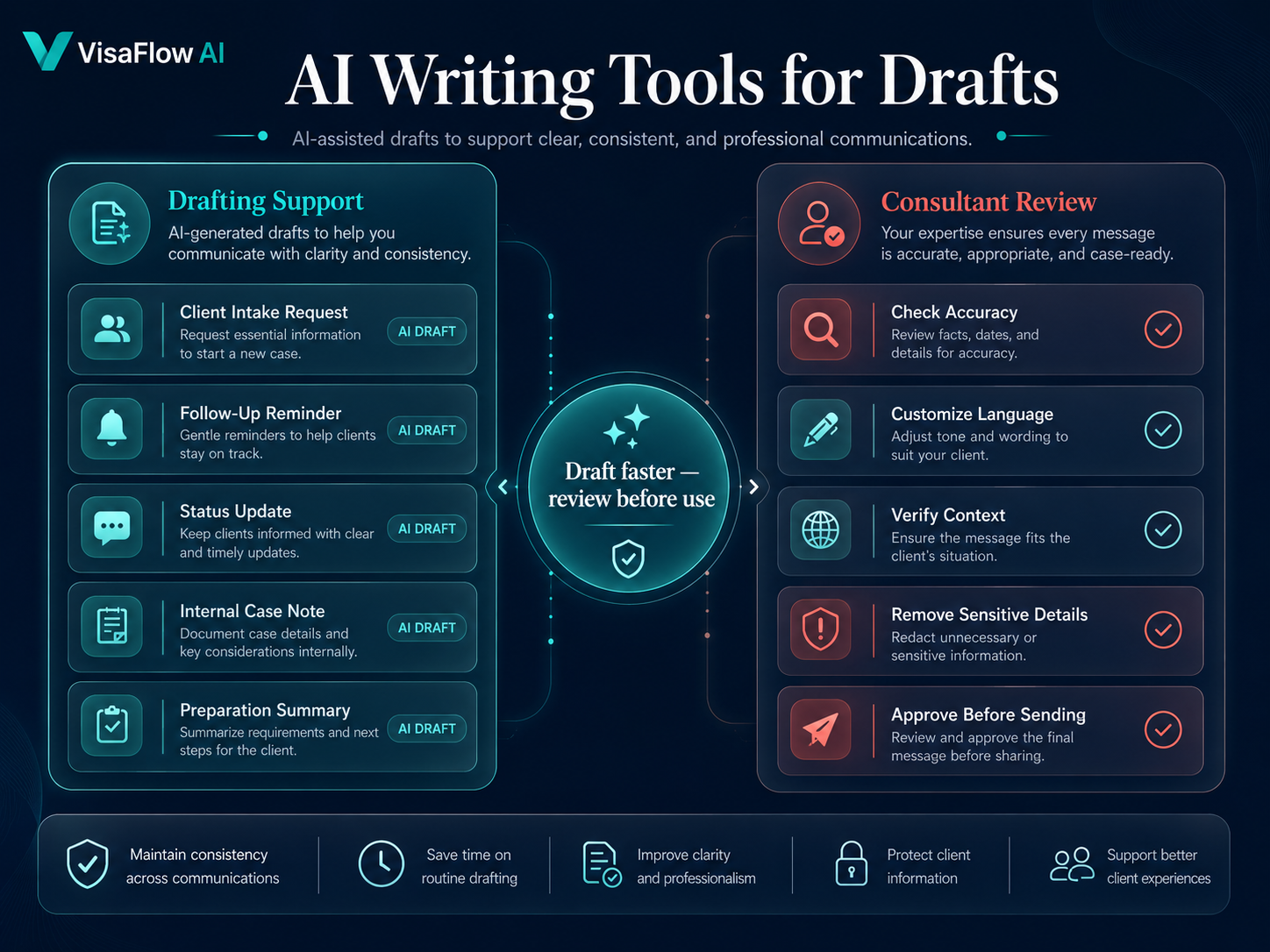
- Always review AI outputs. Every draft, summary, or checklist generated by AI must be reviewed and verified by a qualified consultant before use.
- Verify against official sources. AI summaries of IRCC requirements are starting points. Always confirm information against official IRCC pages.
- Keep client data secure. Be thoughtful about what information is shared with AI tools. Choose platforms designed for professional use with appropriate data handling.
- Maintain professional responsibility. The consultant is ultimately responsible for every client file, communication, and application. AI tools support the workflow but do not share the responsibility.
- Avoid tools with unsafe claims. Any tool claiming to guarantee visa approval, replace professional judgment, or have government affiliation should be treated as a red flag.
Where VisaFlow AI Fits
VisaFlow AI is an AI-assisted workflow platform designed specifically for Canadian immigration consultants. It combines client intake organization, document checklist workflows, source-backed research support, and internal case preparation in one workspace.
Key capabilities include:
- Client intake organization. Structured workspace for client information instead of scattered emails and notes.
- Document checklist workflows. Reusable checklist drafts for common application types with tracking of received documents.
- Source-backed research support. Find and organize IRCC program information with source references for consultant verification.
- Draft preparation. AI-assisted drafting of client messages, follow-ups, and internal notes that the consultant reviews before use.
- Internal case notes. Keep structured notes and preparation details organized per client file.
VisaFlow AI keeps the consultant in control at every step. It is a productivity tool, not a replacement for professional judgment. All outputs require review and verification against official sources.
For a broader overview, see the immigration consultant software page or explore VisaFlow AI features. For pricing, visit the pricing page. For questions, contact the VisaFlow AI team.
Frequently Asked Questions
The most relevant categories include AI-assisted workflow platforms, AI writing and drafting tools, AI research and summarization tools, and AI document organization tools. Each category supports different parts of the immigration workflow, from client intake to case preparation and research.
No. AI tools are productivity aids that can assist with drafting, organizing, and research tasks. They do not replace professional judgment, legal advice, or the consultant's responsibility for each client file. Every AI-generated output must be reviewed and verified by a qualified professional.
Look for tools that keep the consultant in control, support source-backed research, maintain privacy and security standards, and are transparent about what they do and do not do. Avoid tools that claim to replace professional judgment, guarantee outcomes, or imply government affiliation.
Yes. VisaFlow AI is an AI-assisted workflow platform designed specifically for Canadian immigration consultants. It helps with client intake organization, document checklist workflows, source-backed research support, and internal case preparation notes — all while keeping professional review at the center.
No. VisaFlow AI is a productivity and workflow support tool. It does not provide legal advice, immigration representation, or any service that requires licensing as a regulated immigration professional. All outputs must be reviewed and verified by a qualified consultant or authorized team member.
No. VisaFlow AI is not affiliated with IRCC, the Government of Canada, or CICC. It is an independent productivity software product for Canadian immigration professionals. Users should always verify information against official IRCC sources.
Yes, when used appropriately. RCICs and immigration professionals should always review AI-generated outputs against official sources, apply professional judgment, and remain responsible for every client file. AI tools should be used as productivity aids, not as decision-makers.
VisaFlow AI is designed to support immigration consultant workflow productivity. It does not provide legal advice, replace professional judgment, guarantee immigration outcomes, or imply affiliation with IRCC or the Government of Canada. All outputs must be reviewed and verified against official sources by the consultant or authorized team member.